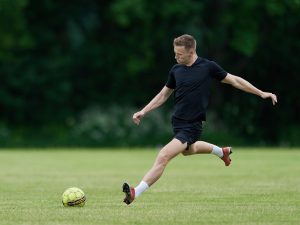

The difference between a player who keeps improving and one who plateaus rarely comes down to talent. It comes down to how they train. Two players can spend the same number of hours on the pitch and develop at completely different rates. The one who improves faster is almost never the one who works harder in a generic sense. They are the one who trains with more deliberate structure.
These soccer training tips are grounded in what sports science and elite coaching practice have consistently shown to work. Not theory for its own sake, but principles that translate directly into better performance on match day.
Why Most Players Train Hard But Improve Slowly
High-volume, low-quality training produces fatigue, not improvement. This is the central problem with how most amateur players approach development. They put in hours, but those hours are not organized around the specific adaptations they need.
Deliberate practice, the framework developed by performance researcher Anders Ericsson and applied extensively in elite sport, requires three things: a specific target for improvement, immediate feedback on whether you are achieving it, and repetition at the edge of your current ability. Most casual soccer training satisfies none of these conditions. Players repeat what they are already comfortable doing, receive no structured feedback, and rarely push into the uncomfortable zone where genuine adaptation happens.
Physical conditioning alone makes this worse. Players who focus exclusively on fitness often do so at the expense of technical and cognitive development. All three dimensions need to run in parallel. Improving one without the others creates imbalances that limit overall performance ceiling.
Technical Training: Building Skills That Hold Under Pressure
Ball Mastery and Touch Development
Daily ball work outside of team training is the single most consistently overlooked development tool for improving players. This does not mean juggling for fifteen minutes before a Netflix session. It means structured ball mastery routines that target specific technical qualities with clear repetition goals.
The distinction matters because unstructured ball work tends to reinforce existing habits. A structured routine targets weaknesses explicitly. Weaker foot development, first touch with different surfaces, receiving under simulated pressure, close control in tight spaces. Players who commit to twenty to thirty minutes of structured ball work daily develop technical consistency that occasionally trained players cannot replicate, regardless of natural ability.
What specifically develops the first touch quality that separates players at higher levels is the combination of repetition volume and progressive difficulty. Start with clean conditions, add movement, then add time pressure, then add a decision. The touch itself is only one layer of the skill.
Training Technique Under Realistic Pressure
Here is the problem with most drill-based training: it works in the conditions it is practiced in. A player who can execute a perfect first touch and pass in an unopposed drill often finds that quality disappears when someone is closing them down and a decision is required simultaneously.
Technique must be trained under time pressure, physical pressure, and cognitive pressure to transfer to matches. Small-sided games, specifically well-designed formats like rondos, three-versus-one possession games, and positional play exercises, create realistic technical demands that isolated drills cannot. The constraint of a real defender and a real decision compresses the skill requirement into something much closer to match conditions.
The training environment must replicate the demands of match conditions. If it does not, the skill you are developing is a training skill, not a match skill.
Physical Development: What Soccer Players Actually Need
Speed, Agility, and Change of Direction
Linear sprint speed is overvalued in soccer development contexts. The average soccer player changes direction every two to four seconds during match play. The physical quality that most determines performance is not top-end sprint speed but acceleration, deceleration, and the ability to change direction at pace without losing balance or position.
Structured agility work, specifically drills that require reactive direction changes in response to a signal rather than pre-programmed patterns, develops the neuromuscular patterns most relevant to soccer. Plyometric training is one of the most underused tools for soccer players at every level. Box jumps, lateral bounds, and depth drops develop the explosive power and landing mechanics that underpin both performance and injury resilience.
Strength Training for Soccer Players
The resistance between soccer players and strength training has largely collapsed at the elite level. The research is unambiguous. Structured strength programs improve sprint performance, reduce soft tissue injury rates, and enhance physical contest ability. The debate is largely over.
At the amateur level, the hesitation persists, usually based on the outdated concern that lifting makes players slower or less agile. Neither is true when strength training is programmed appropriately. Two sessions per week of well-designed resistance training, focused on compound movements that develop posterior chain strength, single-leg stability, and hip power, produce meaningful physical improvements without creating the fatigue that undermines technical training.
Cognitive and Tactical Development
Decision-making speed, spatial awareness, and game reading are trainable. They are not fixed attributes distributed randomly at birth. This is one of the most important and consistently underappreciated principles in player development.
Scanning frequency, the habit of checking over the shoulder before receiving the ball to build a picture of available options, is one of the most directly trainable cognitive skills in soccer. Players who scan more frequently make faster, better decisions because they are choosing from a pre-built picture rather than building it after the ball arrives. This habit can be explicitly drilled and reinforced.
Video analysis of both your own performances and elite players in your position accelerates tactical understanding at a rate that match play alone cannot match. Watching how elite central midfielders position themselves before receiving, how they create angles for the next pass, and how they move defensively without the ball gives you a cognitive template that influences your own decision-making in training and matches.
Recovery and Load Management
Sleep, Nutrition, and Active Recovery
Sleep is the most impactful recovery variable for soccer players and the most frequently neglected. Research consistently shows that sleep quality directly affects reaction time, decision-making speed, sprint performance, and injury rate. A player who trains hard and sleeps poorly is working against themselves in the most fundamental way possible.
Nutrition timing around sessions matters more than total intake alone. Carbohydrate availability before high-intensity sessions affects output quality. Protein intake in the recovery window after training affects muscular adaptation. These are not marginal gains. At amateur level, where recovery protocols are often entirely absent, optimizing sleep and nutrition timing produces performance improvements that would require months of additional training to replicate through volume alone.
Managing Training Load to Prevent Injury
The acute-to-chronic workload ratio is the most reliable predictor of overuse injury risk in soccer players. In practical terms, it means that a sudden spike in training volume relative to what a player has done in the previous three to four weeks dramatically increases injury probability. This is why the first weeks of a new season, and returns from short breaks, are disproportionately high injury periods.
Monitoring load across a week and adjusting individual sessions accordingly is not something reserved for elite environments. Any player can track their weekly training volume, intensity, and physical demands with basic tools and apply the principle of gradual progression. Younger players are particularly vulnerable to load-related injuries because structural development has not fully completed. Their training structures need to reflect that reality.
Mental Toughness and Psychological Preparation
Psychological resilience is a trainable quality. Deliberate exposure to failure in training, practicing skills at the edge of competence where mistakes are frequent, builds the tolerance for failure that match performance demands.
Pre-performance routines, visualization, and structured self-talk do not work because they are mystical practices. They work because they direct attentional focus toward process rather than outcome at the moment when performance anxiety most commonly disrupts execution. A player who has a rehearsed pre-match mental routine is occupying their attention with something controllable, which reduces the cognitive interference that anxiety creates.
Confidence built through structured success experiences in training transfers differently than confidence built through match results alone. A player who can execute a skill reliably in progressively difficult training conditions develops a more stable confidence than one whose self-assessment fluctuates entirely with recent results.
FAQs
How many days per week should a soccer player train to see consistent improvement without risking overtraining?
Four to five sessions per week, balancing technical, physical, and tactical work with at least one full recovery day, optimizes development while managing injury risk effectively.
What is the most important soccer training tip for players who only have limited time each week?
Prioritize technical work under realistic pressure. Short daily ball mastery sessions combined with small-sided game practice produce more match-relevant improvement than longer unfocused sessions.
Should amateur soccer players include strength training, and if so, how often should they lift?
Yes. Two well-designed sessions per week focusing on compound movements, single-leg stability, and posterior chain strength improve performance and significantly reduce soft tissue injury rates.
How does cognitive training differ from tactical training, and why do both matter for soccer development?
Cognitive training develops scanning habits and decision speed. Tactical training builds positional understanding. Both are trainable, and developing them together produces a more complete on-pitch performance.
What is the single most overlooked recovery tool that most soccer players underutilize in their training?
Sleep quality. Research consistently links poor sleep to slower reaction times, higher injury rates, and reduced decision-making speed, making it the highest-impact recovery variable available.